Jim Harper is the father of Boxing Clever Records, a recent addition to the St. Louis ad agency Boxing Clever. We sat down with a bottle of bourbon to talk about his experiences in music and what led him to the crazy idea of starting up a record label.
.
Andrew Doty: A couple of weeks ago, we talked about some of the bands you were in. You started playing in stuff in high school?
Jim Harper: Actually, early college.
AD: You didn't start playing until college?
JH: I've played drums since I was five; I started in big band and swing. And then, I don't want to say I got bored with it, but just like anybody else, I started doing other stuff, and going to school, and whatever. And early college, it was kind of one of those things where it's like, "Don't you have drums or something?" "I don't know, I think?" But I didn't, so a friend of mine gave me his, and of course, I never gave them back. I was at that age where when someone lends you something, you never give it back. And so I had a pair of real thin ultra-tiger-stripe drums. The same kit Bobby Brady got in the Brady Bunch from his dad, or whatever. Started playing with that. Yeah. It's terrible.
St. Louisans have a number of hometown bands to be proud of. Kentucky Knife Fight has been at the forefront of the local scene for a number of years, but that hasn't kept them from several national tours and opening slots for Reverend Horton Heat, Jason Isbell & the 400 Unit, and Pokey LaFarge, among others. The band just finished an intense tour fresh off the heels of losing their beloved van to theft and destruction, but singer Jason Holler says that despite that worrisome start, it "can only be described as our best tour yet. No questions. It was amazing. I'm still slightly in shock. " Lyricism editor Andrew Doty talked with Holler recently about lyrics, music, poetry, and voice.
Andrew: I'd like to start discussing your lyrics way back at the beginning of Kentucky Knife Fight, while you were beginning to cull a loyal following in Edwardsville, IL. If I remember correctly, you were a student at SIUE then taking writing classes when you penned "Got My Heaven," one of KKF's first encore-ready crowd-pleasers. Who influenced you lyrically then, and what sorts of writing have you found new admiration for over the years as you've honed your own penmanship?
I first poured out my heart in this post about Mew at Star Maker Machine. It is copied verbatim here, but you should head over there anyway to have a look around, because it looks very nice, and they've really done a great job with the place.
Mew singer Jonas Bjerre. Photo Credit Bill Ebbesen
"Snow Brigade" fan music video.
This song is always the first that comes to mind when I think of snow songs. I have to admit, that's not very often, nor had I ever even considered the existence of a genre such as "winter pop" until I scoured the internet comments and forums for discussion of this song.
The ever-enlightened, scholarly groupmind of SongMeanings repeatedly amusesaconnectiontococaine, but I can't find anything in the lyrics that clearly prompts such an interpretation on a basic level. With hints of depression, failed communications, a frustrating relationship, and the importance of the season's change, this song is an unreceived broadcast to a partner with Seasonal Affective Disorder.
Mew's homeland of Denmark has a relatively cool climate with heavy, wet winters, during which the daylight time dwindles to just about seven hours—not nearly long enough to even get to enjoy a single, cold moment of sunshine for those of us running on U.S. cubicle work hours. Seasonal Affective Disorder can carry a person's mood quickly into a new personality, a slow shift that grinds the gears of a relationship's communications.
"In winter you're an affliction," the singer of this song tells their partner. There's an argument brewing. Jealous accusations of new interests and demands for evidence. "Enable [me] to bring out the something you want to know beneath the snow," the singer tells the accuser. "Bring out the someone you want to see for jealousy."
Things end on a sour note. The singer's "arms retreat," as the option of immediate reconciliation fades, and the only option is to try again on another day: "I'll find you somewhere / show you how much I care / know that there is no / escape from my snow brigade."
Singer Jonas Bjerre's voice carries the same shrill, tenuous beauty of a tightly-tuned violin string, simultaneously raising the listener's hackles and petting them on the head. This is undoubtedly the first thing that catches the newcomer's ears, but underlying musical experimentations that combine, at times, elements of progressive metal, ambient, noise, and indie pop should not go unappreciated.
Capable of producing albums of catchy singles, like 2003's Frengers, Mew also demonstrates clear understanding of the capability of the album itself as a limit, as No More Stories... and their 2005 album And the Glass Handed Kites both construct single-song façades through the use of song transitions and titular divisions.
Taking theme to the screen as well, Mew enlisted the aid of director Martin de Thurah to deliver a trio of music videos for singles on their release of No More Stories...: "Introducing Palace Players," "Repeaterbeater," and "Beach."
Good news, everyone! Lyricism is going to see lots of new content in 2014, including some site redesign (courtesy of the whiz kids at Boxing Clever and Boxing Clever Records), monthly interviews, and more lyrics than you can shake a stick at.
Featuring loads of new contributors, we'll keep things interesting with content from every genre we can fit in and as much media as our technological prowess can muster.
Plenty in progress at this moment, but for now, we hope we can sate you with a few minutes of amusingly misheard lyrics from 2013.
Today's post is essentially just a redirect to a post I just put on on Star Maker Machine about Peter Bjorn & John's "It Beats Me Every Time" from their 2004 album Falling Out. CHECK IT OUT.
Why a need to crush, to grind or disembowel Why a need to rape, to crucify Why a need to raise, to fly, dictate and rule Why a need to fall Only hell knows*
Sounds like Vader is calling some Christians hypocrites: "Killing in the name of a god is hellish."Not exactly unique for a death metal outfit, but at least they're backed up by some solid research. But is it more metal than that cheerful old hymn from the Christian canon There Is a Fountain Filled with Blood?
Give a glance to this Decibel post, in which Trevor Strnad spends a paragraph describing his lyrics behind each track to the new The Black Dahlia Murder abum Everblack. Nothing better than some lyrical analysis straight from the horse's mouth.
Yesterday, Barrie England shared with us a brief post reciting some lyrics to a French song — the ironically peppy "How do you kill your wife's lover," performed by Jacques Brel — and graced us with some translations. So many thanks, Mr. England! Translations are an important part of sharing ideas; I can never know how much is being said and analyzed around the world if I can't understand it.
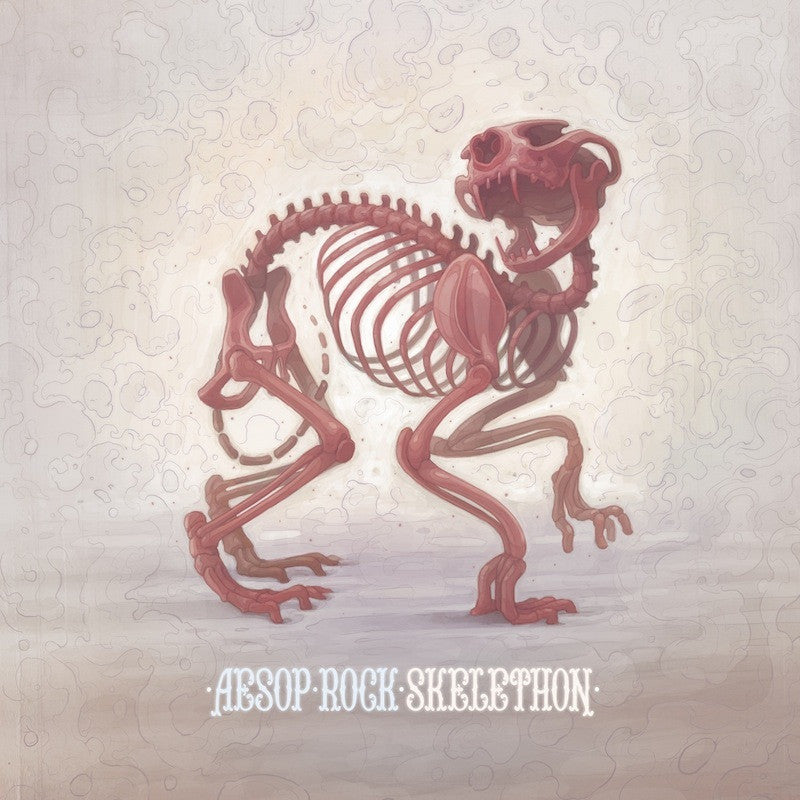
Here is a link to Kyle Ellison's review of Aesop Rock's latest piece of perfection, Skelethon (the full album can be listened to right here on YouTube). Ellison demonstrates a mastery in lyrical dissection and analysis, digesting Bavitz's dense essays of song (the full lyrics, printed in the album insert, occupy pages and pages of tiny font, single space text) and presenting the reader with an easy-to-understand guide of some of the major points made on the album like a Sparknotes entry. For some of Bravitz's explanations of his own songs, check out this playlist of brief interview clips.
As always, check out The Quietus for plenty of other great news and reviews about the music community.
Ephesians 4:26-27, "Be angry, and sin not: let not the sun go down upon your wrath: Neither give place to the devil."
Focusing on the imperatives delivered by the author of Ephesians (not necessarily Paul), Daniel Johnston explicates a few choice passages to explain his own interpretation of the book’s instructions. “Don’t Let the Sun Go Down on Your Grievances”, (not to be confused with the more succinctly titled “Grievances”, in which Johnston lists grievances against an ex-romance) focuses on several Biblical lines, notably Ephesians 4:19 (“Who being past feeling have given themselves over unto lasciviousness, to work all uncleanness with greediness,” compared to “Respect love of the heart over lust of the flesh”) , 4:24 (“And that ye put on the new man, which after God is created in righteousness and true holiness,” compared to “Do yourself a favor: become your own savior”), and 4:26 (cited in the epigraph, compared to a really obvious line).
What drew my attention to this song was the fact that Johnston sings “grievience” instead of “grievances,” as the title would have the listener anticipating (grievience is not yet a word recognized by any dictionary, although an internet search reveals it to be rarely used synonymously with grievance). In fact, the cover version by Clem Snide that appears on The Late Great Daniel Johnston: Discovered Covered represents a reincarnation of this bearing the modified title “Don’t Let the Sun Go Down on Your Grievience”.
Johnston’s message falls in line with a popular maxim for couples that may have initially developed from the Ephesians passage itself: don’t go to bed angry. (Whether you believe this to be good advice or not, it is a sentiment that has been supported very recently by sleep studies.) His belief in Christianity appears to be unwavering, but these lyrics are much more than a banner wave for dogma; they are simply a plea for people to get along with each other.
The messages presented by these lyrics vary. A rejection of carnal exploration in lieu of emotional love certainly has only tangential relations to the practices of dismissing one’s anger and expressing forgiveness. This loose connection supports the biblical basis for the lyrics: Johnston is much more likely to have written this song strictly out of inspiration from reading the passages in Ephesians than by constructing the theme himself and finding biblical references to incorporate.
It’s when Johnston moves into lines like “And yet if you find yourself in the dark, and you’re left holding the bag” and “Sometimes you might want to give up, but keep that chin up” that the listener encounters Johnston’s unadulterated message of hope. “ ‘Cause you’re gonna find” is the vague, unexplained conclusion that drives his optimism. Find what? He’s not telling, and it may be because he doesn’t know any more than you do, and that is exciting to him.
“Start each day with a clean slate,” he implores. “You’ll feel better if you can shake off all that hate.” Biblical influence aside, Johnston’s train of thought is clear: no one knows what tomorrow may bring. If today was rough, tomorrow could be better, but your attitude can make all the difference. Don’t go into a new day carrying the anger of what affected you yesterday; drop it, “and when you wake up in the morning, you’ll have a brand new feeling and you’ll find yourself healing.”
Don't let the sun go down on your grievances Respect love of the heart over lust of the flesh Do yourself a favor: become your own savior
And don't let the sun go down on your grievances
And when you wake up in the morning You'll have a brand new feeling And you'll find yourself healing
So don't let the sun go down on your grievances
And yet if you find yourself in the dark And you're left holding the bag Then take care of it right away
And don't let the sun go down on your grievances again
Sometimes you might want to give up But keep that chin up Cause you're gonna find You're gonna find
Sometimes you might be alone But don't feel lonely 'Cause you're gonna find You're gonna find
So don't let the sun go down on your grievances Start each day with a clean slate You'll feel better if you can shake off all that hate And don't forget to forgive and forget
And don't let the sun go down on your grievances Don't let the sun go down on your grievances
Everybody! Respect love of the heart over lust of the flesh Sing it! Do yourself a favor: become your own savior



.gif "Pew Study")